by Mohamed AMERSI, President of AMERSI Foundation
That hot potato called Middle East…One has to be knowledgeable of history and geography to be able to understand the evolutions thereof.
We are in the business of maps—of power, of ideas, of institutions. Today, two such maps are being redrawn at the same time: the strategic map of the Middle East and the larger map of global order, “Two Maps in Motion”.
Iran sits at the hinge of both processes. It is central to the contest over regional order from Baghdad to Beirut and the Gulf, and it is enmeshed in the wider transition from a US‑centred to a more fragmented, multipolar global system. How we handle Iran will tell us a great deal about the kind of Middle East and the kind of world order will emerge from this turbulent decade.
The regional map and Iran’s structural position appears since 2003, as a new Middle East order has been emerging, defined by fragile balances among Iran, Turkey, Israel, Saudi Arabia, and the UAE, rather than uncontested US hegemony. In that evolving system, Iran is not a peripheral disruptor; it is embedded in every major conflict system—through state links in Iraq and Syria and through non‑state allies in Lebanon and Yemen.
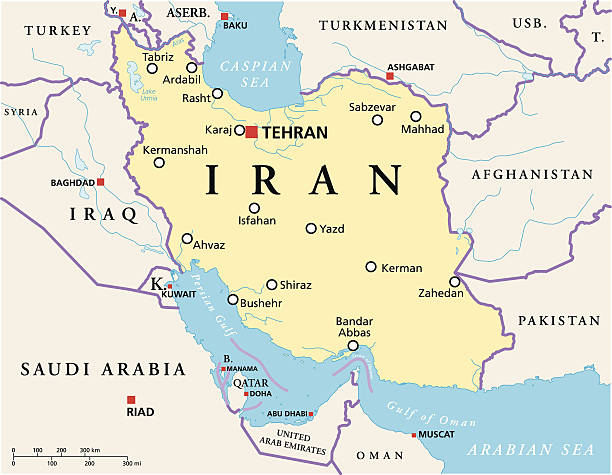
Geography amplifies this role. Iran is the only state that simultaneously touches the Caspian basin, the Gulf, and overland routes linking Central Asia to the Eastern Mediterranean and the Indian Ocean. That position makes its territory a key corridor for energy, trade, and military transit, and any crisis involving Iran reverberates well beyond the Middle East.
Second, Iran’s own narrative is based on Iran’s Multipolar Narrative and “Look East” Strategy. Iranian leaders explicitly frame the current moment as the end of Western unipolarity and the rise of a multipolar order with several centres of power outside the West. This is more than rhetoric; it is a guiding framework for foreign policy, used to justify closer alignment with Russia and China and outreach to like‑minded governments in Latin America, Eurasia, and the wider global South.
Tehran’s “Look East” strategy has translated into accession to the Shanghai Cooperation Organization, entry into an expanded BRICS grouping, and dense bilateral arrangements with Beijing and Moscow. These moves are designed to anchor Iran in alternative financial, technological, and security networks that can cushion Western sanctions and reduce Iran’s regional influence rests not only on geography and diplomacy but also on networks, proxies, and order‑shaping power. Since 1979, the Islamic Republic has invested heavily in relationships with non‑state and hybrid actors—Hezbollah, elements of the Iraqi Popular Mobilization Forces, groups in Syria, and the Houthis in Yemen—alongside ties to Hamas and others. These actors provide Tehran with asymmetric leverage, allowing it to contest US and allied presence while maintaining degrees of plausible deniability.
This networked strategy has been remarkably resilient. It has allowed Iran to shape the political order in neighbouring states, complicate the military planning of adversaries, and sustain an “axis of resistance” that claims to speak for anti‑imperial constituencies across the region. But it also generates structural mistrust: for many Arab governments and for Israel, any “regional order” that leaves these networks intact appears inherently unstable.
The third element is the changing role of the United States. We have a Post‑American, not Post‑Conflict, Middle East. There is a broad, if contested, consensus that the US remains militarily and diplomatically present but no longer defines the regional agenda as it once did. The wars around Iran and repeated escalatory cycles—from the Levant to the Gulf—have eroded confidence in the US security umbrella and encouraged regional actors to diversify both their partnerships and their hedging strategies.
What we see instead is a more crowded landscape:
- US forces and security ties still matter profoundly.
- Russia had entrenched itself in Syria and may still return once the dust settles in Ukraine and maintains defence and energy ties with Iran and others.
- China has become the region’s main trading partner and stepped, cautiously, into a diplomatic role, including brokering the Saudi‑Iran rapprochement.
This is a post‑American Middle East in the sense of reduced dominance, not withdrawal. It is also very clearly not post‑conflict: the instruments of deterrence and escalation management have grown more complex, but they are far from institutionalized.
Iran has become a symbolic and practical test case for multipolarity. Analysts describe it as a state that has refused integration into the US‑led neoliberal order since 1979, and instead positioned itself as part of an emerging non‑Western axis with Russia and China. Its alliance with “resistance” movements, and its efforts to reorient energy and trade flows eastward, are cast as contributions to a more plural international system.
At the same time, for the United States and many European states, Iran is a focal point in defending remaining elements of the liberal order, such as non‑proliferation norms and freedom of navigation. The collapse or erosion of the JCPOA, combined with the expansion of Iran’s nuclear capabilities and missile and drone programmes, is viewed in Western capitals as a challenge not just to regional security but to the credibility of global governance regimes.
What happens with Iran is no longer a “regional problem” to be solved in isolation. It has become a site where the distribution of power, norms, and institutions in the international system is being renegotiated.
For policymakers, the central question is not whether Iran is important, but how to deal with a state that is both structurally embedded and ideologically contested. The clearest options on offer are all imperfect. Hence, the policy dilemma: Containment, Integration, or Managed Ambiguity?
A strategy of hard containment seeks to curb Iran’s capabilities through sanctions, deterrence, and support for its rivals. This can raise costs for Tehran and signal resolve, but it has also entrenched a siege mentality, encouraged nuclear advances, and pushed Iran further into the arms of Russia and China. Conversely, full‑scale integration—treating Iran as a normal regional stakeholder—runs up against Iran’s own use of proxies, human rights record, and ongoing nuclear ambiguity, which many regional states and Western governments see as unacceptable.
In practice, most actors are defaulting to a form of managed ambiguity: selective engagement on de‑escalation and economic ties, combined with episodic coercion and pressure. This is not a grand strategy; it is a holding pattern. It can buy time, but without a clearer vision it risks normalizing permanent brinkmanship.
While governments and alliances fail in finding solutions and even understanding the roots of the problems, policy institutes, universities, foundations, international NGOs, that is the entire Think Tank community may help map the trade‑offs of different orders, rather than debating “for or against” multipolarity in the abstract, may suggest different regional architectures—from US‑centric alliances, to loose balance‑of‑power systems, to more institutionalized cooperative security frameworks that include Iran. The Think Tank community may also conceive the elements of “order by arrangement”, no longer “order by deterrence”, with crisis‑management mechanisms, arms control confidence‑building measures, maritime incident hotlines, and frameworks that link nuclear, missile, cyber, and proxy‑related issues, and it can equally widen the conversation beyond state capitals, as the domestic evolution of Iran—its protests, its demographic shifts, its debates around legitimacy—will shape the sustainability of any external bargain. Engaging Iranian and regional civil society, where possible, and ensuring those perspectives inform elite debates will be crucial.
Iran is undoubtedly a challenge—to regional stability, to non‑proliferation norms, to many of our assumptions about order. But it is also a test: of whether we can design regional and global arrangements that accommodate hard power realities, ideological diversity, and societal aspirations at the same time.
Whether we like it or not, any durable Middle East order will have to be built with Iran in the room, not simply against it. And any credible multipolar world order will be judged, in part, on how it handles cases like Iran—where questions of sovereignty, hegemony, and justice are all in play.

Iran, the New Middle East Order, and an Unfinished Multipolarity. The role of Think-Tanks added by Marcela Ganea on
View all posts by Marcela Ganea →